Zamba por vos
La uruguayaZamba por vos is bound in Lucas Pereyra’s narration to an imperfect ukulele performance beside Magalí Guerra Zabala and to the intimacy that followed it. The song’s significance lies less in a successful rendition than in its afterlife as a way of returning, through repeated singing, to one charged moment with her.
The song at the seawall
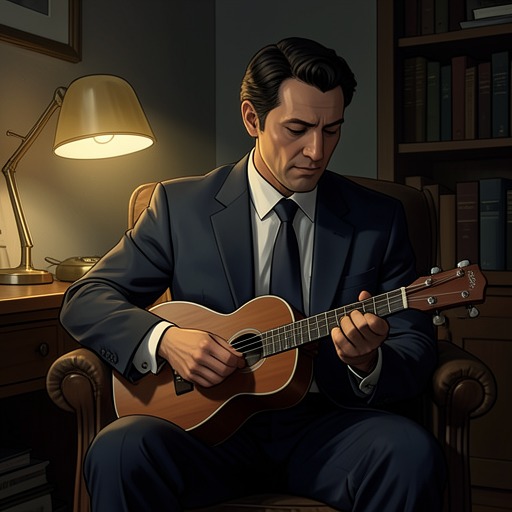
Lucas tries to pick out Zamba por vos on his ukulele while he and Magalí Guerra Zabala sit sheltered beside a seawall. He cannot find the chords; what he knows of guitar only confuses him further. He recalls that his attempts did not sound good, making the scene’s musical failure part of its particularity rather than an obstacle the story conceals.
The lyric he associates with his performance is “Yo no canto por vos: te canta la zamba”. The recollection preserves the song as something he was trying to use to impress her, even as his attention shifted from the instrument to Magalí, absorbed in a lollipop.
From performance to intimacy
The song belongs to a small, concrete sequence of shared gestures. Magalí’s lollipop is violet and Lucas’s is red; they ask to taste one another’s, exchange them, and kiss, with the different flavors carried into the memory of their kisses. The ukulele remains in the scene, but the exchange between the two becomes its emotional center.
That closeness deepens on the sand, where they kiss and touch beneath the seawall’s shelter. Lucas’s later account gives the song a place at the threshold of this intimacy: it is the imperfect overture to a moment he remembers not as an ordered conversation but as whispered words without space between them.
Repetition and remembered presence
Lucas distinguishes the failed attempt from the way he plays the song now: he says he can perform it without mistakes, with picked notes. Yet technical improvement does not replace the original scene. Each time he sings it, he says, he is back beside Magalí, trying to impress her with his version. The present-tense act of singing thus repeats the memory rather than correcting it out of existence.
Zamba por vos becomes a personal mnemonic: a song whose words, instrument, and remembered setting converge on one encounter. Its recurrence holds both the awkwardness of the first performance and the tenderness that followed, keeping the beachside moment available to Lucas whenever he plays and sings.